Every Asset You Own Depends on Something. This One Doesn't.
Most people spend their entire financial lives building assets they don't actually control.
Real estate that depends on a tenant. A portfolio that depends on the Fed. A business that depends on customers showing up. Gold that depends on collective belief that it's worth something.
The word independence gets attached to all of it. But independence requires that something function on its own. And not one of these assets does.
That's not a minor caveat. It's a structural problem — one that becomes very visible the moment any of those external conditions stop cooperating.
Every conventional asset class has a dependency chain. There is one form of capital that doesn't.
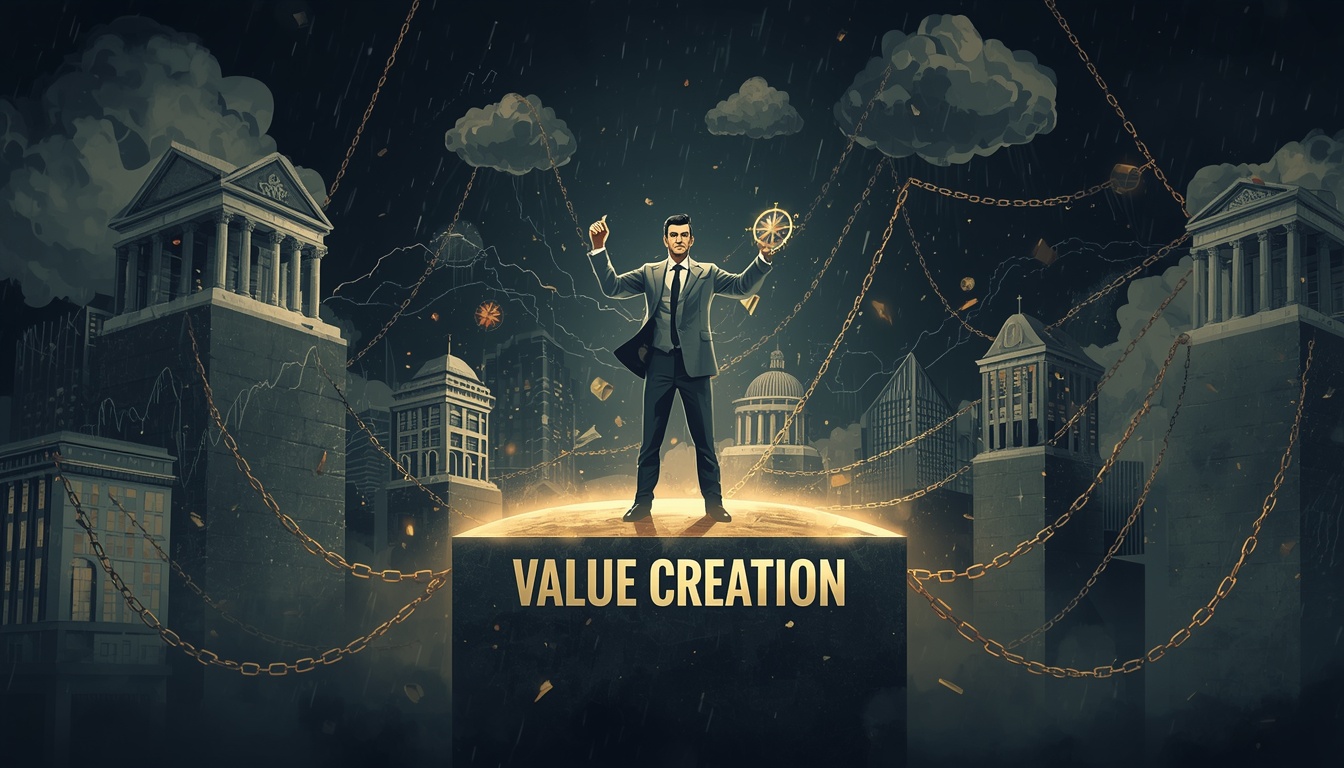
Your ability to create value — to think, navigate, pivot, and produce something the market wants — is the only asset whose continued function depends entirely on you. Not on a central bank. Not on a tenant. Not on a regulator, a market maker, or an employer.
That distinction matters more than most financial frameworks are willing to admit.
Every asset class taught in conventional financial planning comes with a hidden counterparty.
Real estate is the most obvious. A rental property produces income when a tenant pays. It appreciates when credit is cheap and money is abundant. Remove the tenant, tighten the credit markets, or let the Fed reverse course — and the asset that was supposed to be your foundation becomes a liability you're responsible for carrying. The property doesn't adapt. You do.
Equities carry the same structural problem, just wrapped in more abstraction. Owning stock means depending on a company's management to make sound decisions, on consumer demand to hold, on earnings to grow, and on the broader market to price that growth rationally. In 2022, stocks and bonds declined simultaneously — an outcome that decades of conventional diversification theory said couldn't happen. The portfolio didn't pivot. The investor had to. As we explored in Dependent Independence: The Illusion of Financial Freedom in the Stock Market, owning different tickers inside the same system isn't diversification of risk — it's diversification of symbols while the underlying dependency remains intact.
Gold is perhaps the most intellectually honest of the conventional alternatives. Its value is almost entirely a function of shared human belief. That belief has proven durable over centuries — but it is still belief. Gold in a vault cannot respond to a changing environment. It sits and waits for the world to continue agreeing on its worth.
Even a privately owned business carries its own dependency structure. Customers have to keep buying. Employees have to keep performing. The market has to remain open to what you're selling. Businesses fail. Industries shift. A product that was indispensable five years ago can be commoditized or obsolete today. The business itself cannot adapt. Its owner has to.
The pattern across all of these is the same: the asset produces when conditions cooperate. When conditions stop cooperating, the asset waits — and the person who owns it bears the cost.
Your ability to create value is the only exception to that pattern.
Not the outcomes of that ability. A business built on your skills can still fail. A product you created can still lose its market. Marketing dollars can go to waste. A client you served for years can walk. Those are outcomes, and outcomes are always conditional on some version of external cooperation.
The capacity beneath those outcomes is something different.
The ability to recognize an opportunity, design a response to it, take action, absorb the feedback, and do it again — that process lives entirely inside you. No monetary policy decision affects it. No tenant default erases it. No market crash eliminates it. No employer can revoke it and no regulator can price it out of reach.
When a business fails, a person who understands this rebuilds. When a market crashes, a person who understands this looks for what the crash creates. When the conditions that supported a previous strategy disappear, a person who understands this finds new conditions to work with. The ability to pivot is not a consolation prize for when things go wrong. It is the asset itself.
This is not an argument against owning real estate, equities, or building a business. Those assets compound. They produce. They matter. But they matter downstream of something more foundational — and most financial education skips that foundation entirely in favor of discussing what to buy and where to hold it.
The more useful question is: what produces the producer?
The conventional answer is inheritance, luck, or access to capital. Those are real inputs. But the actual answer — the one that holds across different markets, different economic cycles, and different historical periods — is the sustained ability to create value and direct it intentionally.
That ability is not inherited. It is built. And unlike every other asset on the balance sheet, it cannot be marked down, foreclosed on, or confiscated. It compounds through use rather than through waiting. And its value increases precisely when the conditions supporting every other asset class deteriorate — when the environment is most uncertain and the ability to navigate it is most scarce.
This is also where the financial identity spectrum becomes clarifying. There is a stage most high earners reach — what we've described elsewhere as the Fragile Independent — where asset accumulation creates the feeling of freedom without the actual condition of it. The portfolio is large. The income streams are multiple. But every one of those streams still requires the right external conditions to produce. The Fed has to cooperate. The tenants have to pay. The market has to hold. Remove those conditions and the independence dissolves.
Genuine capital independence doesn't start with owning the right assets. It starts with recognizing that the most durable asset you have was never something you could purchase. And protecting that capacity — the judgment, the creative ability, the resilience that generates everything downstream — is the foundational act of wealth building that almost no one discusses.
Not a portfolio large enough to survive external disruption. A capacity resilient enough to operate through it.
The Critical Thinking Three
1. If the external conditions supporting your current income disappeared tomorrow — the tenants, the market, the clients — what would you actually do? Not in theory. Not eventually. Tomorrow. The clarity or panic in your honest answer tells you something important about where your real foundation is.
2. How much of what you call financial independence is actually financial permission — permission granted by a central bank, a creditworthy tenant, or a functioning market? Those conditions can be withdrawn. Independence that requires permission isn't independence. It's a dependency with a better name.
3. When did you last treat your ability to create value as something worth investing in deliberately? Not your portfolio. Not your asset allocation. The judgment, pattern recognition, and creative capacity that produced the resources you're now trying to protect. Most people optimize the downstream while the upstream quietly atrophies.
Wealth & Liberty is an educational platform. Nothing in this article constitutes financial, legal, or tax advice. Always consult a qualified professional before making financial decisions.
If this article raised questions about how your current financial structure is built — and whether it's designed for genuine control or just accumulation — the team at Producers Wealth works exclusively with business owners and high-income earners on exactly that problem.