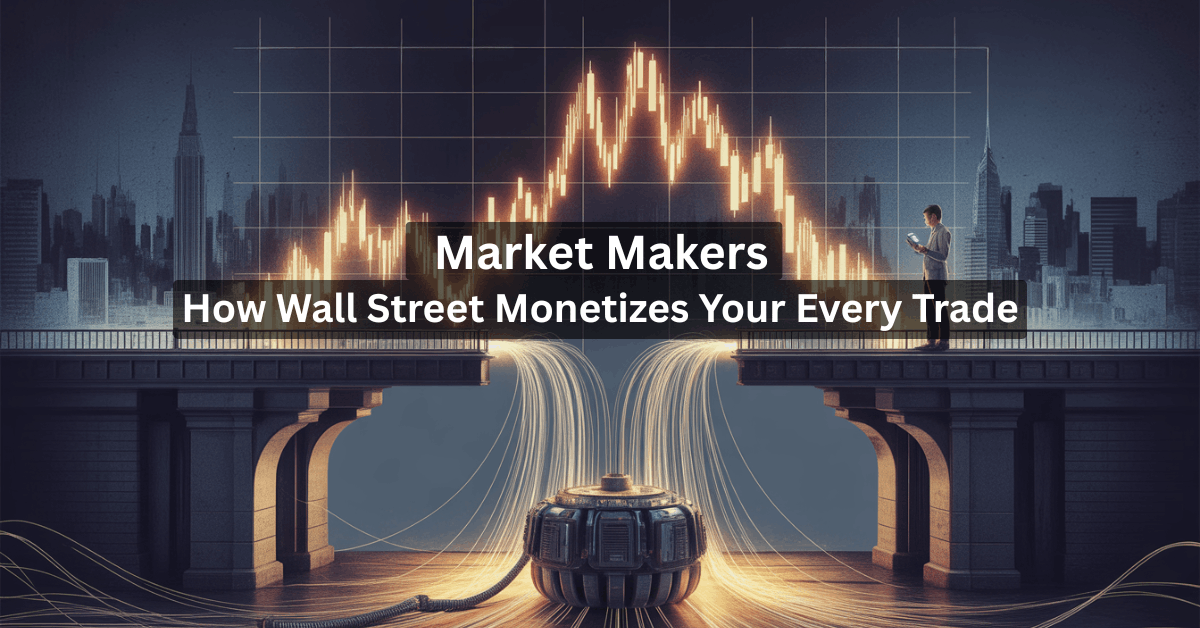
Market Makers: How Wall Street Monetizes Your Every Trade
Every time you place a trade, someone on the other side of that transaction makes money.
Not your broker. Not the company you are buying stock in. Not the market itself.
A market maker. A firm whose entire business model is to sit between you and the price you think you are getting — and extract a fraction of every dollar that passes through.
Multiply that fraction by billions of trades per day, and you begin to understand what is actually happening inside the financial system most investors trust with their family’s future.
The machinery is legal, largely invisible, and operating every single time you click buy.
What a Market Maker Actually Does
Market makers are firms — often high-frequency trading operations — that provide continuous buy and sell prices for securities. They quote a bid (the price they will buy from you) and an ask (the price they will sell to you). The difference between those two prices is called the spread.
That spread is not random. It is the market maker’s profit margin, baked into every transaction by design.
If a stock’s true value is $100.00, a market maker might quote a bid of $99.97 and an ask of $100.03. You buy at $100.03. Someone else sells at $99.97. The market maker pockets $0.06 and takes on essentially no directional risk — because their business is not about whether the stock goes up or down. Their business is the spread itself.
This sounds like a small number. It is — per trade. But market makers operate at a scale most investors cannot conceptualize. They process millions of transactions daily across thousands of securities. The spread on each one may be pennies. Aggregated across the volume of a single trading day, it is an enormous, predictable, guaranteed revenue stream.
And it comes entirely from the investors on both sides of every trade.
Payment for Order Flow: The Hidden Arrangement Inside “Free” Trading
In recent years, the rise of commission-free brokerage apps convinced millions of retail investors that they were finally getting a fair deal. No transaction fees. Free trades. The democratization of investing.
What those investors were not told clearly is that their “free” broker was selling something else: their orders.
This is Payment for Order Flow — PFOF. Brokers route their clients’ orders not to the exchange that might offer the best price, but to market makers and wholesale trading firms that pay the broker for the right to execute those orders. The market maker fills the order, profits from the spread, and the broker collects a per-share payment for delivering the flow.
The investor pays no visible commission. The broker earns revenue from the wholesaler. The market maker profits on the spread. Everyone wins — except the investor, who may be receiving slightly worse execution than they would on a transparent exchange and has no practical way to measure the difference.
The SEC requires brokers to seek “best execution” for their clients. But best execution is not required to mean best price. It can mean the best combination of factors — a standard vague enough that routing decisions can favor broker economics without technically violating the rule.
📖 Related: The Gap Between the Marketing & the Math — The financial industry is extraordinarily skilled at making arrangements that serve its own interests while presenting them as services to clients. PFOF is one of the clearest examples in modern markets.

Why the Default Narrative Fails
The standard response to concerns about market makers is: competition keeps spreads tight. In liquid markets — large-cap stocks with heavy volume — spreads are often a fraction of a penny. The cost is negligible.
That is partially true and partially a distraction.
It is true that spreads in heavily traded large-cap stocks have compressed dramatically over the last two decades. For a retail investor buying Apple or Microsoft, the spread-related cost on any single trade is minimal.
But several other factors matter and rarely get discussed.
Liquidity is not constant. During periods of market stress — exactly when investors most want to act — spreads widen dramatically. Market makers are not required to maintain quotes during volatility. They can pull back, widen spreads, and wait. The investor who assumed smooth execution discovers that the cost of transacting during a crisis is far higher than it was during calm markets. The wealth plan built on assumed liquidity runs directly into this reality.
Not all securities are equally liquid either. Spread costs in mid-cap, small-cap, international, or less-traded securities can be substantial. A “diversified” portfolio with exposure beyond large-cap U.S. equities is absorbing meaningful spread drag in portions of its holdings that most investors never calculate.
And the information asymmetry is structural. Market makers operate with speed and order-flow data that no retail investor can access. They can see patterns in incoming orders before those orders are filled. They adjust quotes in microseconds based on information retail investors do not have and cannot obtain. This is not illegal. It is the designed architecture of the market.
📖 Related: How Fees, Taxes, and Emotions Are Quietly Stealing 70% of Your Return Potential — The visible costs of investing are rarely the largest ones. Spread drag, adverse execution, and hidden PFOF arrangements stack on top of management fees, tax drag, and behavioral costs to create a compounding burden most investors never quantify.
📖 Related: The 4 Forces Quietly Destroying Your Wealth — Market maker extraction is one layer of a broader structural drag on wealth that most investors never add up across a full investing lifetime.
You Are Not Playing the Same Game
The most important thing to understand about market makers is not the spread. It is the asymmetry.
Market makers have co-location arrangements with exchanges — their servers sit physically inside exchange data centers to minimize the microseconds of signal travel time. They have proprietary order-flow data. They have algorithms operating at speeds no human can match.
You have a brokerage app.
These are not two players competing on the same field. They are participants in structurally different games that happen to share a price ticker. The market maker’s edge is speed, information, and infrastructure. The retail investor’s edge — if it exists — is time horizon, discipline, and the ability to avoid being forced to transact.
This is actually useful information. If you cannot compete on speed or information, the rational response is not to try. It is to reduce transaction frequency, extend your time horizon, and shift capital toward structures where you are not the uninformed party in an information-asymmetric trade.
Contractual, long-duration assets do not require you to transact in a market maker’s arena. Their value accrues through time and contract rather than through price discovery in a system optimized for volume and intermediary revenue.
📖 Related: Compared to What? The Financial Spectrum No One Explains — Before deciding how much of your capital belongs in public markets, you need an honest comparison against alternatives that don’t route through the same extraction architecture.
📖 Related: A Nation of Speculators — Most retail investors are participating in public markets with far less understanding of the structure they’re inside than they realize.
Implications for Real Wealth
None of this means public markets are a trap. They are a tool — one that comes with structural costs most investors do not fully account for.
The practical implication for a serious wealth-builder is not panic. It is clarity. Know what you are paying. Know who is extracting value from your participation. Know that “free” brokerage is not free — it is a business model in which your order flow is the product. Know that the liquidity you assume will be available may not be available at the price you expect during the moments you most need it.
And ask whether every dollar of your capital needs to participate in a system designed around the economics of its intermediaries — or whether some portion belongs in structures where the only party profiting from your capital is you.
The families building durable wealth are not necessarily abandoning public markets entirely. But they are asking a question most investors never think to ask: who is making money on my participation, and am I accounting for that cost in my expectations?
If you want to stress-test how much of your current wealth is exposed to structural costs like these, The Fragility Test is a free 10-minute diagnostic that identifies exactly where your capital is structurally exposed. No pitch afterward — just the clarity of running an honest diagnostic.
If you’re ready to explore what a capital structure looks like where fewer hands are in the flow — where your capital compounds under contractual terms rather than market-maker terms — the team at Producers Wealth builds that specifically for business owners and high-income earners.
Not ready to talk yet? Join the Wealth & Liberty newsletter — one idea per week on building wealth that holds up under the conditions that actually test it.
The Critical Thinking Three
- Have you ever calculated the total spread, execution drag, and order-flow cost your portfolio has absorbed over its lifetime — and if not, why has no one offered to show you that number? If your broker benefits financially from the routing decisions they make on your behalf, whose interests are they actually optimizing?
- The liquidity in your portfolio exists in calm markets. Does it still exist under the conditions that would actually force you to act — a market crisis, a personal liquidity need, a period of elevated volatility? The investor who discovers conditional liquidity during a crisis discovers it at the worst possible time.
- What portion of your capital genuinely requires daily-liquid, exchange-traded exposure — and what portion is simply there because no one has offered a credible alternative structured around your actual time horizon and control preferences? The answer to that question is worth more than most portfolio optimization conversations ever produce.