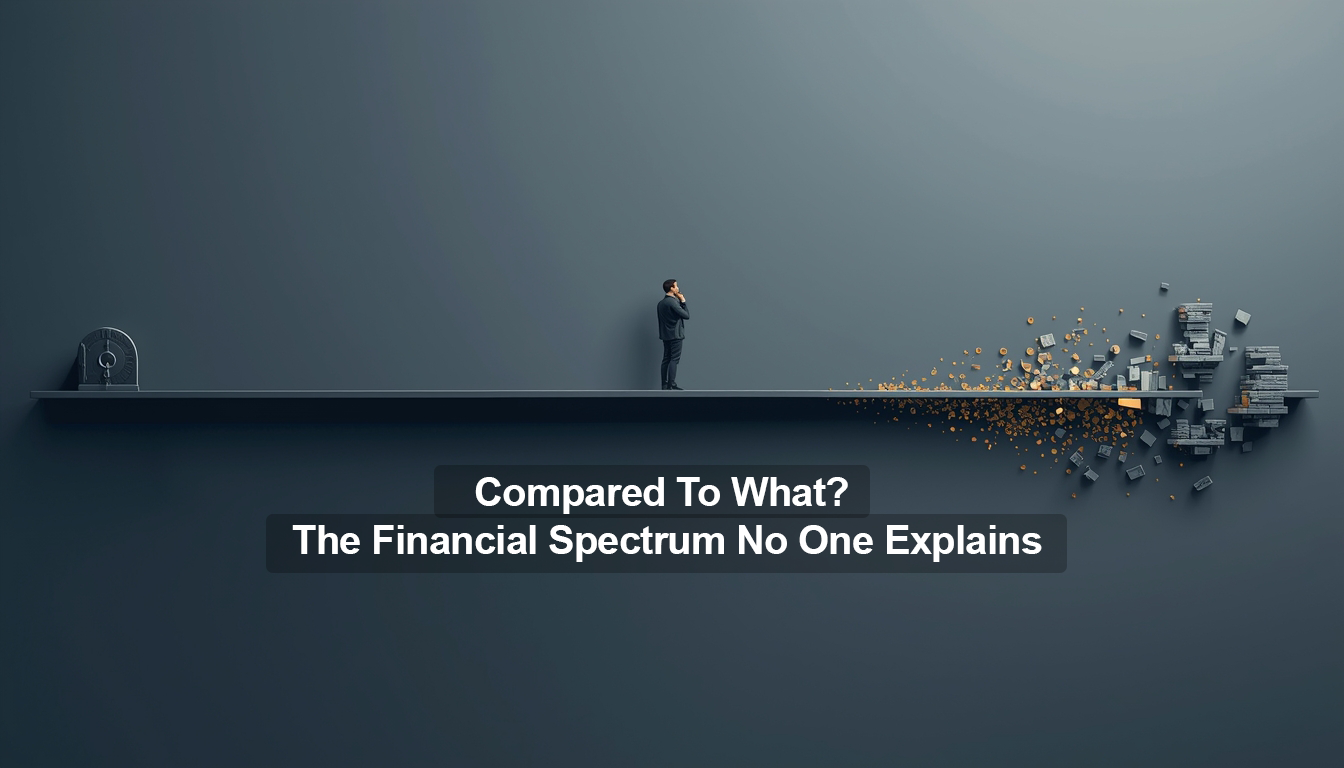
Compared to What? The Financial Spectrum No One Explains
Nobody walks into a fruit stand, bites into a mango, and complains it doesn’t taste like a strawberry.
You already know going in that they’re different. Different texture. Different sweetness. Different experience entirely. You don’t compare them — you choose them based on what you actually want.
And yet, every single day, people do the financial equivalent of biting into a mango and wondering why it doesn’t taste like a strawberry.
They put dollars into a savings vehicle and complain it doesn’t grow like an investment.
They put dollars into a stock portfolio and panic when it doesn’t behave like a savings account.
They compare a whole life insurance policy’s 4% guaranteed growth to the S&P’s headline 10% — and declare the comparison settled.
It isn’t.
Because before any comparison means anything at all, you have to ask the question almost no one asks:
Compared to what?
The Spectrum Most People Never See
All capital lives somewhere on a spectrum — from complete certainty to pure chance. The problem isn’t that people use different tools. The problem is that they use different tools and expect the same outcome.
That’s not analysis. That’s confusion.
There are four distinct financial behaviors, each with its own purpose, risk profile, and reasonable expectation. Mixing them up is where most financial mistakes actually begin — not in the assets themselves, but in what people expected from them.
Saving: The Job Is Certainty, Not Growth
Savings live on the far-left end of the spectrum. Their job is not to make you wealthy. Their job is to be there when you need them.
Savings prioritize capital preservation, liquidity, and stability. Returns are low because the value isn’t the return — it’s the reliability.
A savings vehicle answers one question exceptionally well: Will this money be here when I need it?
It does not answer: How do I grow wealth? How do I stay ahead of inflation? How do I build something that lasts?
Comparing a savings account to a growth asset because the numbers look different is a category error. They aren’t competing. They’re doing completely different jobs — like comparing a mango to a strawberry and being surprised they’re not the same.
This is exactly where whole life insurance cash value belongs on the spectrum. It is a savings vehicle — not an investment. Safe, no volatility, accessible, with conservative guaranteed growth of 3–5%. But here’s what makes it genuinely different from a standard savings account: your dollar performs multiple jobs at once. The same dollar providing liquidity and guaranteed growth is simultaneously providing a death benefit, long-term care protection, and asset protection. No savings account does that.
If you’re comparing whole life’s growth rate to the stock market’s return, you’ve already asked the wrong question.
📖 Related: Why Banks Love Life Insurance — Bank of America holds over $25 billion in life insurance on their balance sheet. They’re not doing it for the yield. They’re doing it because they understand what a savings vehicle that performs multiple jobs is actually worth.

Investing: Trading Certainty for Expected Growth
Move rightward on the spectrum and you arrive at investing.
Here, you accept uncertainty in exchange for expected — but not guaranteed — growth. Investing typically involves longer time horizons, volatility along the way, and faith in productive assets and systems over time.
Crucially, investing means placing capital in something you know, like, and understand. Not something you heard about, not something your brother-in-law recommended, not something trending on social media. Something you have genuine conviction about — with a low probability of permanent loss.
Investing answers a different question than saving does: If I stay disciplined long enough, what is the expected result?
The hidden risk in investing isn’t just volatility. It’s time mismatch — needing capital sooner than expected and being forced to sell at the wrong moment. That’s where investing quietly becomes destructive without anyone noticing until it’s too late.
📖 Related: The Misrepresentation of the “Average Rate of Return” — The gap between what the market “averages” and what investors actually keep is wider than most people ever calculate.
Speculating: Betting on Being Right
Speculation disguises itself as investing constantly. The financial media helps. So does dinner party conversation.
The difference is this: investing is a bet on a system or asset over time. Speculation is a bet on being right about timing, price, or narrative. It requires entry and exit precision, behavioral discipline, and the ability to correctly anticipate what other market participants will do next.
Speculation isn’t inherently evil. But mislabeling it is dangerous.
When people believe they are investing — accepting long-term risk with disciplined intent — but are actually speculating — betting on near-term price movement — they behave incorrectly on both ends. They hold too long, or panic-sell too early. They confuse volatility with failure and bull runs with skill.
📖 Related: A Nation of Speculators — Most retail participants in public markets are speculating, not investing. And most of them don’t know it.
Gambling: Pure Chance
At the far right of the spectrum is gambling.
No productive asset underneath. Negative expected value over time. Outcomes driven entirely by randomness. No compounding advantage. No system you can learn or improve at meaningfully over time.
Gambling doesn’t answer any long-term financial question. The danger isn’t even the loss — losses are survivable. The danger is confusion. When gambling masquerades as investing, the discipline that makes wealth possible evaporates entirely.
It’s All Relative — And That’s the Point
Here’s where it gets important: what counts as investing for one person may be pure speculation for another.
If you’ve spent twenty years in multifamily real estate — you understand the markets, the financing, the operating nuances, the failure modes — that’s an investment for you. You know it, like it, and understand it. The probability of success is high because your knowledge manages the risk.
Give that same multifamily deal to someone with no experience, no operational understanding, and no framework for evaluating it? That’s speculation at best. Gambling at worst.
The asset didn’t change. The investor did.
This is why knowing your investor DNA matters more than any individual opportunity. Your capital allocation should reflect what you actually know — not what sounds compelling.
📖 Download: The Capital Decision Filter — A free framework for evaluating any financial decision against the criteria that durable wealth actually requires.
Why “Compared to What?” Changes Everything
Risk and return are never absolute. They are always relative. And every financial decision should be evaluated against the correct alternative — not just any alternative that comes to mind first.
Compared to holding cash.
Compared to paying down guaranteed interest on debt.
Compared to another asset in the same category.
Compared to doing nothing.
Compared to sacrificing liquidity or control.
A speculative asset compared to a savings account is meaningless — they aren’t doing the same job.
A long-term investment compared to a short-term liquidity need is reckless — they exist on different timelines.
A 10% volatile return compared to a 4% guaranteed, tax-advantaged, asset-protected, death-benefit-carrying return is not the slam dunk it appears to be — because you’re not comparing apples to apples. You’re comparing a mango to a strawberry and wondering why one doesn’t taste like the other.
📖 Related: Artificial Wealth: When Prices Rise but Value Doesn’t — Before comparing returns, you need to understand what drove them. Not all gains are created equal.
Most financial mistakes aren’t caused by bad assets. They’re caused by bad comparisons — evaluating one thing against the wrong standard, then drawing confident conclusions from a fundamentally flawed question.
The Real Goal Is Alignment, Not Maximum Return
Every dollar in your financial system has a job. The goal isn’t to maximize return across every dollar. The goal is to make sure each dollar is doing the job it was assigned to do — and being evaluated accordingly.
Some dollars should protect. Some should grow. Some should create optionality and flexibility. Some should never be risked at all.
When you misclassify capital — asking a savings vehicle to perform like a growth asset, or asking a speculative position to provide the certainty of savings — you introduce fragility into the entire system. You take risks you didn’t intend. You sacrifice liquidity without realizing it. You make decisions in crisis conditions that were never designed for crisis conditions.
📖 Related: The 3 Forces Quietly Destroying Your Wealth — Misalignment is one of the quietest and most consistent wealth destroyers there is.
Clarity begins when every dollar has a job — and is judged only against the standard that job actually requires.
Your Challenge This Week
Pull out your balance sheet — or just think through what you own.
For each asset, ask three things: Is this saving, investing, speculating, or gambling? Is that role intentional — or did it drift there accidentally? And is this asset being compared to the right alternative?
Most people have never done this exercise. That alone puts you ahead of almost everyone.
If you want help thinking through it, the team at Producers Wealth works specifically with business owners and high-income earners on building capital structures where every dollar has an intentional role — and every comparison starts with the right question.
The Critical Thinking Three
- Do you actually know what job each dollar in your balance sheet is assigned to do — or is your money drifting without intent?
- What assets do you own that you thought were savings, but don’t actually preserve capital or maintain liquidity when you need them most? What would it take to fix that?
- What assets do you own that you thought were investments, but depend on being right about timing, price, or narrative? How would you behave if those positions moved against you for 24 months?
Not all returns are created equal.
Not all risk is the same.
And no financial decision should be made without first asking:
Compared to what?
Want to think through your own capital structure with a clear framework? Download The Capital Decision Filter free — or start a conversation with Producers Wealth about building a system where every dollar has a job.
Not ready for a conversation yet? Join the Wealth & Liberty newsletter — one idea per week that reshapes how you think about money.